








Document download: World Neurology - November-December 2025

Description:
World Neurology: November-December 2025 Volume 40, No. 6
Release date: 18 Dec 2025
Published: 19 Jun 2026
Filename:
wn_nov_dec25.pdf
File type and size:
pdf, 5.64 MB
View/download:
Published by Ascend Integrated Media LLC, Kansas, USA
From the editors
Steven L. Lewis, MD, Editor, and Walter Struhal, MD, Co-Editor
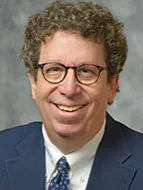
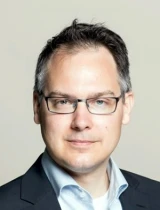
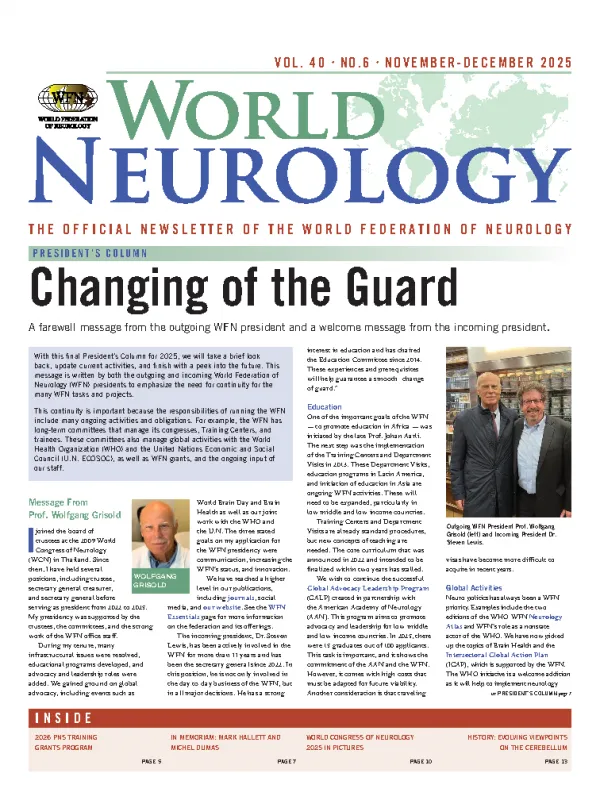
Welcome to all readers from around the globe to the December 2025 issue of World Neurology, the final issue of this calendar year.
In the President's Column, Prof. Wolfgang Grisold, who completes his term as president of the World Federation of Neurology (WFN) at the end of this month, provides us with an overview of his remarkable and illustrious tenure with the association. He is passing the baton to the next president, Dr. Steven Lewis, who provides a brief preview of the next presidential term.
The editors would also like to extend our sincere gratitude to Prof. Guy Rouleau, who finishes his successful term as WFN vice president and leader of our WCN Congress Committee at the end of this month. His immense contributions to the WFN and our congresses position us well for the future.
In the History Column, Dr. Peter J. Koehler delves into the historical aspects of the nonmotor functions of the cerebellum. This issue also features news from Drs. Andreas Kattem Husøy, Yvonne Yiru Xu, and Timothy J. Steiner, who summarize the recent results from the Global Burden of Disease study. The study shows that headache disorders are a leading cause of health loss globally, with one-fifth being due to medication overuse. This issue includes reports from Drs. Luis Querol and Camila Castelo Branco Pupe, on behalf of the Peripheral Nerve Society, highlighting global programs such as leprosy awareness, funding initiatives, and outreach opportunities. Prof. Lawrence Tucker, president of the African Academy of Neurology, recounts a trip he and Prof. Grisold made to the University Training Hospital (UTH) in Lusaka, Zambia.
Dr. Rachel Forman, a stroke neurologist from Yale University, and two colleagues, provide information about a unique public school program intended to advance stroke education and community awareness. It is never too early to provide education and advocacy about brain health to the public. Connor McGinnis, a medical student from the United States, summarizes his experience rotating through the Neurology on Wheels initiative in rural India, led by Dr. Bindu Menon (and previously highlighted in World Neurology).
This issue also features an account from Dr. Cynthia Marleny Aliñado Ramos, a young neurologist from Guatemala. She recently successfully completed her one-year stroke fellowship at the highlevel neurology institutions comprising the WFN-accredited Training Center in Mexico City. There is also a Junior Traveling Fellowship report from a young neurologist from Kyrgyzstan, who presented her research at the Asian and Oceanian Parkinson's Disease and Movement Disorders Congress.
This issue features additional photo highlights of activities of the recent World Congress of Neurology (WCN) in Seoul, South Korea. (See the September-October 2025 issue for additional photos.) The next WCN will be held in October 2027 in Cape Town, South Africa.
We say goodbye to two giants of international neurology who recently passed away: Prof. Mark Hallett (a previous editor of World Neurology) and Prof. Michel Dumas.
We again thank all neurologists and neurologic trainees from all regions of the world for your interest in the WFN and World Neurology.
In closing, we would like to once again acknowledge Prof. Wolfgang Grisold, for his untiring devotion to global neurology, the WFN, and brain health for all throughout his tenure as WFN president. ■
Highlights
President's Column
-
Changing of the Guard ⧉
By Wolfgang GrisoldI joined the board of trustees at the 2009 World Congress of Neurology (WCN) in Thailand. Since then, I have held several positions, including trustee, secretary general-treasurer, and secretary general before serving as president from 2022 to 2025. My presidency was supported by the trustees, the committees, and the strong work of the WFN office staff.
During my tenure, many infrastructural issues were resolved, educational programs developed, and advocacy and leadership roles were added. We gained ground on global advocacy, including events such as World Brain Day and Brain Health as well as our joint work with the WHO and the U.N. The three stated goals on my application for the WFN presidency were communication, increasing the WFN's status, and innovation...
Around the World
-
University Training Hospital in Lusaka, Zambia ⧉
By Prof. Lawrence TuckerThe University Teaching Hospital (UTH) in Lusaka is the largest public tertiary hospital in Zambia. It is also the main institution training center for health care professionals and includes the country's only neurology training center. There are currently 21 neurologists in Zambia, which has an estimated population of 21 million people. Most of those 21 neurologists were trained at the UTH. The UTH neurology training center was established in 2018 and currently graduates approximately three neurologists per year. Prior to 2018, there were only one or two neurologists in the entire country. The center trains both adult and pediatric neurologists. The establishment of this training program was led by Prof. Deanna Saylor and is supported by the Johns Hopkins Global Neurology Program...
-
2026 PNS Training Grants Program ⧉
By Luis Querol, PhDA collaboration in Derby, Connecticut, is bringing together Yale School of Medicine, Griffin Hospital, and Derby Public Schools with the FAST Heroes program to strengthen stroke awareness across the community. The initiative uses the FAST Heroes curriculum, an interactive stroke educational program based on the FAST stroke recognition acronym: Face, Arm, Speech, Time. It was developed at the University of Macedonia in Greece. The curriculum is supported by the Angels Initiative, a health care intervention program dedicated to improving stroke survival. It was developed by pharmaceutical company Boehringer Ingelheim...
-
Empowering Children to Recognize Stroke Symptoms ⧉
By Rachel Forman, Kalliopi Tsakpounidou, and Michael RaffertyThe Peripheral Nerve Society (PNS) continues its long-standing tradition of fostering the next generation of researchers and clinicians dedicated to tackling peripheral nerve disorders. This commitment is exemplified by the PNS Training Grants Program, which has recently been named in honor of Prof. Laura Feltri. This recognizes her outstanding scientific legacy and her unwavering dedication to mentoring young investigators in the field. The PNS Laura Feltri Training Grants Program aligns with the PNS's mission to "advance knowledge and improve the lives of people with peripheral neuropathies."...
-
Insights Into Headache Disorders ⧉
By Andreas Kattem Husøy, Yvonne Yiru Xu, and Timothy J. SteinerThe Global Burden of Disease (GBD) report, the most comprehensive study of death and health loss globally, probably needs no introduction to most readers. New estimates for the entire series (from 1990 onward) are published every two years. The standardized method, including calculation of years lived with disability (YLD), allows for a comparison of the burden between disorders...
-
Neurology on Wheels: We Reach, We Teach, and We Treat ⧉
By Connor McGinnisTraveling from the United States to the coast of India and through its remote villages was never part of my medical curriculum, yet when the opportunity to learn from Dr. Bindu Menon, neurologist and founder of Neurology on Wheels, presented itself, I knew I could not pass it up. After obtaining a grant, months of planning, and more than 24 hours of travel, I was warmly welcomed to India with a decorative shawl. Over the course of one of the most enlightening weeks of my life, I witnessed Indian health care with its emphasis on preventive neurology, timely bedside diagnoses, and an inspiring sense of gratitude. This powerful triad left every patient in a better place — the ultimate goal within medicine. The emphasis on preventative care and symptom recognition is essential...
-
Leprosy Awareness Podcast Series ⧉
By Camila Castelo Branco Pupe, PhDLeprosy is one of humanity's oldest diseases. Yet, it is still a frequent cause of peripheral neuropathy worldwide, especially in certain endemic areas. Although leprosy is a treatable and curable disease, it remains prevalent in several regions of the world due to the underdiagnosis of new cases, which sustains transmission within communities. The disease is complex and sometimes difficult to recognize, especially in its pure neuritic forms. Even though leprosy is primarily a neurological condition, it has historically received little attention from neurologists. This has resulted in delays in diagnosis and management. Effective control depends on training clinicians to identify early neurological signs and initiate prompt treatment, preventing disability, and interrupting transmission chains.
WFN Training Center Report
-
Stroke Visiting Fellowship Program in Mexico ⧉
By Cynthia Marleny Aliñado RamosI am honored to present the final report of my participation in the One-Year Stroke Visiting Fellow Program. My visit took place from September 2024 to August 2025 in Mexico. I had the privilege of rotating at the General Hospital of Mexico Dr. Eduardo Liceaga (HGM), the National Institute of Medical Sciences and Nutrition Salvador Zubirán (INCMNSZ), and the National Institute of Neurology and Neurosurgery Manuel Velasco Suárez (INNNMVS). Each of these institutions contributed in different ways to my training in vascular neurology, providing a comprehensive and highly enriching experience...
Junior Traveling Fellowship 2025
-
Abstract Presentations and Colleague Collaborations in Tokyo ⧉
By Medetbekova SezimA s part of my participation in the World Federation of Neurology (WFN) 2025 Junior Traveling Fellowship program, I successfully attended the Asian and Oceanian Parkinson's Disease and Movement Disorders Congress (AOPMC) from March 21-23, 2025, in Tokyo. While there, I presented my abstract, "Awareness of Parkinson's Disease Among the Population of Kyrgyzstan." The AOPMC brings together doctors, researchers, and other health care professionals to collaborate and share ideas that advance movement disorder science and care...
History
-
Evolving Viewpoints on the Cerebellum ⧉
By Peter J. KoehlerIn classical antiquity, the pneuma psychikon, a supposed volatile substance that was transmitted from the cerebral ventricles to the nerves, was considered the instrument of the soul. In the early medieval period, the cerebral ventricles (called "cells" rather than the cerebral substance) were considered important. Nemesius of Emesa (c. 390) connected Greek physiology with Christian concepts and localized the psychic pneuma in these hollow spaces in the head. The localization was as follows...
In memoriam
-
Prof. Mark Hallett, MD (1943-2025) ⧉
By Prof. Tissa WijeratneThe global neurology community mourns the loss of Prof. Mark Hallett, MD, whose passing in 2025 marks the end of an era in movement disorders and motor control research. Born in 1943, Prof. Hallett became one of the most influential neurologists of his generation, shaping both the science and spirit of modern neurology. Prof. Hallett's academic journey, which began at Harvard Medical School, progressed through his formative years in London and culminated in his decades of leadership at the National Institute of Neurological Disorders and Stroke (NINDS), reflects an unwavering commitment to scientific discovery. As chief of the NINDS Human Motor Control Section, he laid much of the foundation for how we currently understand dystonia, tremor, functional movement disorders, and the physiology of voluntary movement...
-
Prof. Michel Dumas, MD (1934-2025) ⧉
By Pierre-Marie Preux and Amadou Gallo DiopWe are deeply saddened to announce the passing of Prof. Michel Dumas, who died Nov. 8, 2025, in Limoges, France. After having contributed to the establishment of the first Francophone Departments of Neurology in West and Central Africa and trained the first professors and teams — thereby helping to bridge major human resources gaps in sub-Saharan Africa — Prof. Dumas joined the Faculty of Medicine at University Hospital of Limoges, France, in 1976. He founded and chaired the Department of Neurology until 2000 and served as vice dean from 1980 to 1990...




Web design by Tribal Systems, built on Zenario