









Document download: World Neurology - January-February 2026
Description:
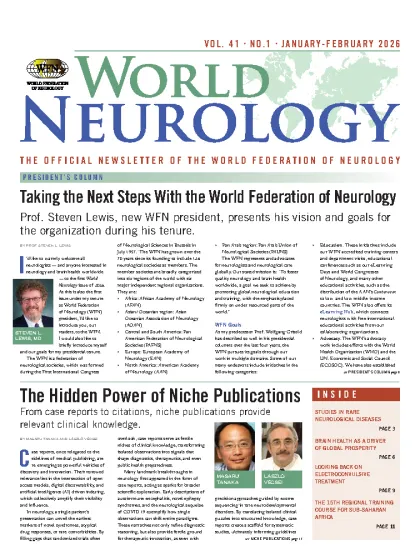
World Neurology: January-February 2025 Volume 41, No. 1
Release date: 3 Mar 2026
Published: 18 Mar 2026
Filename:
wn_jan_feb26.pdf
File type and size:
pdf, 6.70 MB
View/download:
Published by Ascend Integrated Media LLC, Kansas, USA
From the editors
Steven L. Lewis, MD, Editor, and Walter Struhal, MD, Co-Editor

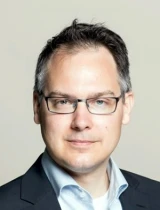
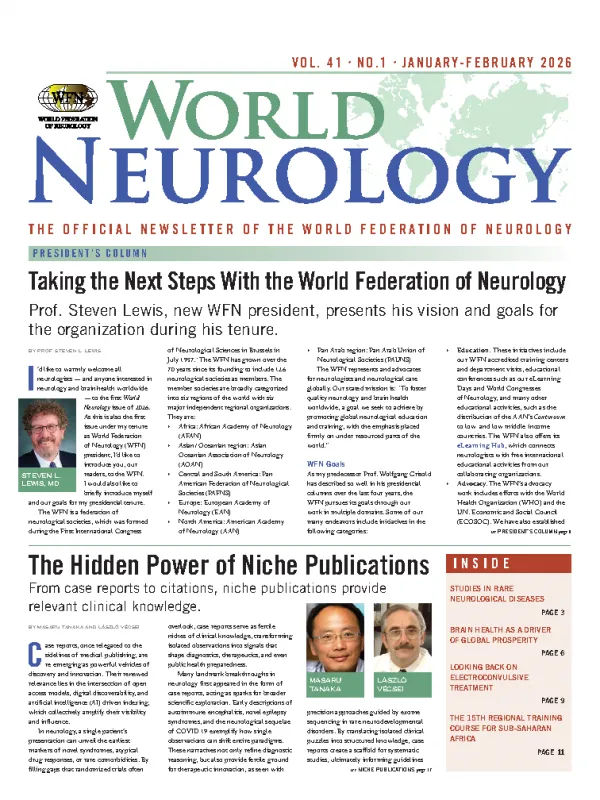
I'd like to warmly welcome all neurologists — and anyone interested in neurology and brain health worldwide — to the first World Neurology issue of 2026. As this is also the first issue under my tenure as World Federation of Neurology (WFN) president, I'd like to introduce you, our readers, to the WFN. I would also like to briefly introduce myself and our goals for my presidential tenure.
The WFN is a federation of neurological societies, which was formed during the First International Congress of Neurological Sciences in Brussels in July 1957.1 The WFN has grown over the 70 years since its founding to include 126 neurological societies as members. The member societies are broadly categorized into six regions of the world with six major independent regional organizations. They are:
- Africa: African Academy of Neurology (AFAN)
- Asian/Oceanian region: Asian Oceanian Association of Neurology (AOAN)
- Central and South America: Pan American Federation of Neurological Societies (PAFNS)
- Europe: European Academy of Neurology (EAN)
- North America: American Academy of Neurology (AAN)
- Pan Arab region: Pan Arab Union of Neurological Societies (PAUNS)
The WFN represents and advocates for neurologists and neurological care globally. Our stated mission is: "To foster quality neurology and brain health worldwide, a goal we seek to achieve by promoting global neurological education and training, with the emphasis placed firmly on under-resourced parts of the world."
As my predecessor Prof. Wolfgang Grisold has described so well in his presidential columns over the last four years, the WFN pursues its goals through our work in multiple domains. Some of our many endeavors include initiatives in the following categories: Education. These initiatives include our WFN-accredited training centers and department visits, educational conferences such as our eLearning Days and World Congresses of Neurology, and many other educational activities, such as the distribution of the AAN's Continuum to low- and low-middle-income countries. The WFN also offers its eLearning Hub, which connects neurologists with free international educational activities from our collaborating organizations.
Advocacy. The WFN's advocacy work includes efforts with the World Health Organization (WHO) and the U.N. Economic and Social Council (ECOSOC). We have also established World Brain Day as an annual event highlighting brain health initiatives worldwide. • Publications. WFN's official research journals include the Journal of the Neurological Sciences, eNeurological Sciences, and this publication, World Neurology. • WFN Specialty Groups. These groups have fostered the establishment and nurturing of academic collaborations in the neurological community. The WFN has a myriad of other longstanding and ongoing initiatives which, along with the above, will be discussed in future editions of World Neurology. The WFN has also been critically and firmly involved in the overarching goal of promoting brain health worldwide, a concept that has grown exponentially and globally over the last few years and has been long ingrained in the WFN's motto. ■
Highlights
President's Column
-
Taking the Next Steps With the World Federation of Neurology ⧉
By Prof. Steven L. LewisI've been a WFN trustee for over 11 years, most recently as the secretary general. My main responsibilities included overseeing the secretariat in London and overseeing compliance with U.K. charity laws. With my career interest in education, I've chaired the WFN Education Committee and have helped hone and grow the many activities my predecessors shaped under their leadership. My non-WFN U.S.-based educational endeavors have included stints as chair of the organizations that certify neurologists and accredit residency and fellowship training programs in the U.S. As a former and current editor-in-chief of several neurological journals/ publications, I have enjoyed bringing high-level, evidence-based, contemporary neurologic education to a global audience...
Announcement
-
Nominate Candidates for WFN Secretary General, Trustee ⧉
By Prof. Steven Lewis, WFN President, and Laura Druce, WFN CEOThe World Federation of Neurology (WFN) invites nominations for two positions up for election in 2026. They are: Secretary general, a 4-year term (2027-2030) Elected trustee, a 3-year term (2026-2029) The WFN encourages all member societies to suggest suitable candidates for both positions. Engagement in the WFN and neurology in a global context are expected. Availability, readiness for communication, and experience with international and global societies are required. English is the WFN's primary communication language. The submission deadline is Friday, April 17, 2026...
-
'My FIGHT With PD' - Author Blacker shares his story of living with Parkinson's disease. ⧉
By Prof. Tissa WijeratneIn 2020, the World Federation of Neurology (WFN) launched World Brain Day with the theme of "Stop Parkinson's Disease." The first voice heard on the global webinar was that of Prof. David Blacker, who movingly shared his own story as a neurologist living with Parkinson's disease (PD). That video captured the attention of thousands of people worldwide, and his new book, "My FIGHT With PD," builds on that moment with honesty, science, and hope...
Around the World
-
The Future of Pediatric Neurology ⧉
By Prof. Pratibha SinghiOn behalf of the organizing committee, it is my pleasure to invite you to participate in the upcoming International Child Neurology Congress (ICNC) 2026. It promises to be an exciting and enlightening experience. The International Child Neurology Association's Scientific Committee has curated a program that seamlessly blends modern advancements with practical approaches in child neurology...
-
Brain Health as a Driver of Global Prosperity ⧉
By Morris FreedmanThe Davos Alzheimer's Collaborative (DAC) Brain House, in partnership with the Science for Africa Foundation, convened a landmark conference, Brain Health as a Driver of Global Prosperity: A G20 Call to Action, on Nov. 4, 2025, in Johannesburg, South Africa. I attended as a representative of the World Federation of Neurology (WFN), serving as a trustee and treasurer...
-
The 15th Regional Training Course for Sub-Saharan Africa ⧉
By Dr. Yousef PatelThe 15th European Academy of Neurology-African Federation of Neurology (EAN-AFAN) Regional Training Course for Sub-Saharan Africa was held Nov. 27-29, 2025, in Windhoek, Namibia. The Regional Training Courses are academic initiatives organized under the auspices of the AFAN and the EAN (and other supporting global neurological associations such as the World Federation of Neurology (WFN), Movement Disorder Society, International League Against Epilepsy, American Academy of Neurology (AAN), and others). The courses are aimed at strengthening neurology residency training across the continent...
WFN Training Center Report
-
A Year of Learning in Cairo ⧉
By Aba Cissé, MDI would like to extend my appreciation to the World Federation of Neurology (WFN) and the Association of British Neurologists (ABN) for the one-year neurology training opportunity in Cairo. Having Egypt as the destination of my first scientific trip was amazing. My journey in this country, rich with stories and knowledge, started in September 2024. I was welcomed by Prof. Ahmed Abdelalim, who introduced me to the department and staff members. The training began as soon as my registration was done. The warm welcome I received made me feel right at home...
History
-
Looking Back on Electroconvulsive Treatment ⧉
By Peter J. KoehlerLast year, I received an antique electroconvulsive treatment (ECT) device for placement in the museum of the Dutch Trefpunt Medische Geschiedenis Nederland [Meeting Point Medical History, the Netherlands]. It was probably produced in the 1950s by a Dutch company called Elther, likely a contraction of "electric therapy." Looking at the small but heavy device, I wondered when and how neuropsychiatrists began working with it. What happened in the 1970s? Is it still used today? This article will examine the possible answers to those questions...




Web design by Tribal Systems