|
-
By Dr. Yousef Patel
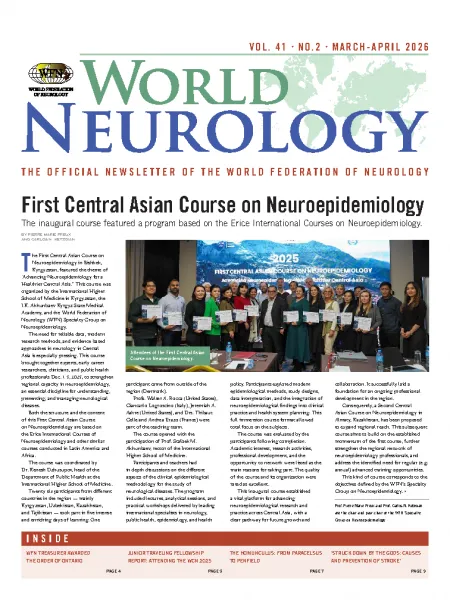
Supported by global partners such as the World Federation of Neurology and the American Academy of Neurology, the course emphasized its theme, “Neurology Without Borders,” highlighting the shared continental responsibility to advance brain health in Africa through collaboration, ethical practice, skills development, and strong regional networks.
-
By Prof. Massimo Leone
Sub-Saharan Africa has 1.3 billion inhabitants. The estimated number of PLWE in the region exceeds 20 million, but there is only one neurologist for every 2 million people.
The majority of PLWE in Sub-Saharan Africa are managed in primary care facilities by nonphysician clinicians (NPCs) whose education on the disease is insufficient. More than 75% of PLWE have little or no access to treatment. The Sub-Saharan African population is expected to double by 2050, as is the number of PLWE.
-
By Ndonji Chiwaya
Educators in Zambia decided to challenge the status quo with a fresh approach: the flipped classroom model. No more marathon lectures with passive note-taking. Instead, students viewed neurology content before class via prerecorded online video lectures. They then spent valuable class time participating in interactive, small-group discussions focused on real clinical cases...
-
By Dr. Aida Suárez-Gonzalez, Prof. Morris Freedman, Dr. Thomas Bak, Prof. Adesola Ogunniyi, Prof. Gladys E. Maestre, and Prof. Raj Kalaria
Dementia and Brain Aging in Low- and Middle-Income Countries, a symposium held Dec. 3-6, 2024, in Nairobi, Kenya, marked another milestone in global efforts to advance equitable brain health. Hosted at the Safari Park Hotel, the event brought together more than 200 delegates from Africa and the world, representing a wide spectrum of researchers, clinicians, and policymakers. The setting underscored the meeting's purpose: to center the voices, knowledge, and experiences of those working within low- and middle-income countries (LMICs), where the burden of dementia is growing rapidly...
-
By Dr. Chandrashekhar Meshram
The Orange City Cultural Foundation (OCCF), in collaboration with the P.M. Shah Foundation, Nagpur Municipal Corporation, Rashtrasant Tukadoji Maharaj Nagpur University, CineMontage, and Saptak Napur, organized the Orange City Aarogya Film Festival on March 29-30, 2025, in Nagpur, India.
This initiative, a brainchild of Dr. Chandrashekhar Meshram, president of the OCCF and trustee of the World Federation of Neurology (WFN), was the first health-focused film festival in central India. The idea was to create health awareness in the general public and inspire people to do good work on health-related issues...
Open latest issue
|
-
Wei Zhao, Siefaddeen Sharayah, Michael R. Butler, Kathryn Forsman, Kaley J. Marcinski Nascimento, Rejean M. Guerriero, Rikke S. Møller, M. Scott Perry, Fábio A. Nascimento
This review examines the role of neonatal Fc receptor (FcRn) inhibition as a novel targeted strategy for treating chronic inflammatory demyelinating polyradiculoneuropathy (CIDP), an immune-mediated disorder that causes progressive weakness and sensory loss. While standard therapies like immunoglobulins, corticosteroids, and plasma exchange effectively manage symptoms for many, they are limited by non-responsiveness, persistent residual deficits, side effects, and administration logistics. By clearing pathogenic IgG antibodies, FcRn inhibitors address these unmet needs, highlighted by the Phase 3 clinical success and subsequent approval of efgartigimod.
-
Wei Zhao, Siefaddeen Sharayah, Michael R. Butler, Kathryn Forsman, Kaley J. Marcinski Nascimento, Rejean M. Guerriero, Rikke S. Møller, M. Scott Perry, Fábio A. Nascimento
A retrospective study evaluated the implementation and outcomes of a specialized adult-based epilepsy transition program (ETP) in the United States, designed to transfer pediatric epilepsy patients into adult care. Led by an adult epileptologist specializing in pediatric epilepsies, the program analyzed 135 patients with a median age of 21 years who completed initial visits between July 2022 and January 2025.
-
Jin Jun Luo, Shaun Wang, Xiaohong Si
This article reviews the emerging applications, existing evidence, and clinical challenges associated with utilizing chimeric antigen receptor T-cell therapy for the treatment of various neurological disorders.
-
Mariana Letícia De Bastos Maximiano, Ocílio De Deus da Rocha Ribeiro Gonçalves, Filipe Virgilio Ribeiro, Ahmet Gunkan
This observational study investigates the clinical practice and timing of initiating or reinitiating oral anticoagulation therapy in real-world patients diagnosed with atrial fibrillation who have experienced an intracerebral hemorrhage.
-
Toljan K, Amin M, Scarsella M, Purohit M, Mullaguri N, Wisco D, Man S, Uchino K.
A new study explores the overlap between posterior reversible encephalopathy syndrome (PRES) and reversible cerebral vasoconstriction syndrome (RCVS), two disorders linked to cerebrovascular dysregulation. While traditionally considered separate conditions, the findings suggest overlapping presentations may occur more frequently than previously recognised.
-
Sekendiz Z, Caliendo M, Taboada D, An T, Palekar N, Weisenbach S, Kim MJ.
A new study investigates the potential role of neuroinflammation in persistent neuropsychiatric symptoms of Long COVID in older adults. While the biological basis of these symptoms remains unclear, chronic inflammatory processes have been increasingly suspected as a key driver.
Open latest issue
|
OPEN ACCESS JOURNAL
-
Saleem S, Kamal AK, Aziz N, Hasan S, Khan AS, Mubarak F, Shakeel E, Durrani R, Qamar S, Sattar S, Asghar S.
eNeurologicalSci. 2026 Feb 27:100606.
This study evaluated a high-fidelity simulation training program for hyperacute Stroke management among healthcare professionals in Pakistan, conducted at Aga Khan University. The course significantly improved participants’ confidence and performance in stroke triage, communication, clinical assessment, and treatment decision-making. Findings also highlighted systemic challenges such as the absence of standardized stroke pathways and workflow delays, reinforcing the value of structured, team-based simulation training in improving acute stroke care.
-
Kaindl L, Hotz JF, Ferrari J.
eNeurologicalSci. 2025 Jun 1;39:100561.
Stroke represents a major public health problem, ranking as a leading cause of death and long-term disability worldwide. The goal of prevention strategies is to avoid the occurrence of stroke by educating both healthcare professionals and patients about the reduction of risk factors.
Despite increasing improvements in acute revascularization therapies, preventive measures remain more effective in decreasing the burden of stroke, as evidenced by the fact that over 75 % of strokes are first events. This paper attempts to provide a comprehensive approach by outlining risk factors and new therapeutic approaches. Understanding these is essential for healthcare providers and the general public to develop effective prevention strategies and ultimately reduce the overall incidence of stroke.
-
Aka KC, Nancy ED, Muriel AT, Cedric AP, Delors OF, Arlette AD, David B, Axel TB, Constance YE, Christian T, Evelyne AD.
eNeurologicalSci. 2025 Apr 15:100566
This was a prospective cross-sectional study carried out during the 2022–2023 academic year at the Abidjan UFR of Medical Sciences. The study population consisted of all students in years 3ème to 6ème and hospital interns. The Schon questionnaire, transcribed using google form software, was sent to students using the "whatsapp" social network.
-
Grisold W, Lewis SL.
eNeurologicalSci. 2025 Jan 5;38:100548
Congresses remain the main source of scientific meetings, combining science and education as well as personal interactions. Congresses are slowly returning to in-person meetings; however, some organizations, such as the World Federation of Neurology (WFN), adhere to the hybrid concept, both virtual and in-person.
To do this, we host the WFN World Congresses of Neurology (WCN), which reports the latest achievements and will remain hybrid (https://wcn-neurology.com); however, we think that two years between congresses is too long. For this reason, we introduced the World Federation of Neurology Digital Neurology Update (WNU)
-
Crivelli L, Winkler A, Keller G, Beretta S, Calandri I, De Groote W, Fornari A, Frontera J, Kivipelto M, Lopez-Rocha AS, Mangialasche F.
eNeurologicalSci. 2024 Nov 21:100539
Open latest issue
|